Showing posts with label grace. Show all posts

Saturday, April 23, 2016

Be Sensible: Teach Sound Doctrine and Faith


In Titus, chapter 1, Paul gave instructions to Titus on how to appoint godly leaders. In chapter 2, Paul commands Titus and the church leaders to be sound teachers. This includes older men, older women, young men, and even slaves are instructed to demonstrate utter faithfulness to their master so that they might "adorn the teaching of God our Savior in everything." 

How does a slave obey and show utter faithfulness to a master? This is a concept we, Americans, have a difficult time grasping in the 21st century. However, we must go back to what the church was instructed to be. In Titus 2, older men were to be: self controlled, worthy of respect, sensible, and sound in faith, love, and endurance. Older women were to be: reverent in behavior, not slanderers, not addicted to much wine, teachers of what is good, and encouraging younger women to love their husbands and children.

Young men were to be: sensible "about everything," an example of good works, having integrity and dignity in teaching, having a message that is beyond reproach so that the opponent would be ashamed and have nothing bad to say.
Since the word sensible was used throughout this chapter, I decided to look it up online. This is what I found on dictionary.com.
Synonyms
1. intelligent, sagacious, rational, reasonable. See practical2. conscious, understanding, observant. 4. perceptible, discernible, palpable.

At this point, I have modified my blog from my original post. How does sensibility, intelligence, consciousness, and understanding (a few of the key words above) relate back to sound teaching?

The words intelligent and sagacious remind me of the many scriptures that explain how we are to seek wisdom from God. Some examples: 1 Corinthians 1, James 1:5.


And applying this wisdom to faith, it is impossible to please God if we do not have faith, live a life worthy of Him, evidenced by good works (Colossians 1:10).

In the Bible in Ephesians chapter 2, verses 8-10, we learn that it is not good works that save us, it is our faith--the good works result from this faith and this relationship with God:
"For by grace you are saved through faith, and this is not from yourselves; it is God's gift--not from works, so that no one can boast. For we are His creation--created in Christ Jesus for good works, which God prepared ahead of time so that we should walk in them."
The last part of Titus 2 concludes with verses 11-15, and they are very important and noteworthy for all people as an eternal promise and gift from God, if we choose to accept His gift of salvation.
"For the grace of God has appeared, with salvation for all people, instructing us to deny godlessness and worldly lusts and to live in a sensible, righteous, and godly way in the present age, while we wait for the blessed hope and the appearing of the glory of our great God and Savior, Jesus Christ. He gave Himself for us to redeem us from all lawlessness and to cleanse for Himself a special people, eager to do good works. Say these things, and encourage and rebuke with all authority. Let no one disregard you."


Monday, March 14, 2016

Joshua at Jericho: The Lord Will Fight for You


When Joshua was near Jericho, he looked up and saw a man standing in front of him with a drawn sword in his hand. Joshua asked him, "Are you for us or for our enemies?" The man replied, "Neither, but as commander of the army of the Lord, I have now come." Joshua bowed face down to the ground in reference to him and asked what message the Lord had for him, his servant? The commander of the Lord's army replied, "Take off your sandals, for the place where you are standing is holy."

Commander of the Lord's Army

A Long Journey


The Israelites have journeyed 40 years in the desert to finally arrive at the land the Lord had promised to their ancestors. Along the journey, they ate manna from heaven daily and followed the leadership of Moses and Aaron, and then now Joshua. Miraculously, when they reached the flooding waters of the Jordan River, while the Levitical priests carried the Ark of the Covenant, the Israelites walked across the river bed on dry ground. After they were safe at Gilgal, the flood waters returned as before. One man from each tribe (12), placed a stone at Gilgal as a memorial to share with future generations.

The military aged men along the journey had all been circumcised, but while in the desert, none of their sons had been. The Lord God told Joshua to make flint knives and circumcise all the Israelite males before proceeding to Israel. Then they celebrated the tradition of Passover and ate produce from the land of Canaan. The next day, the manna, which they had been receiving for 40 years, ceased. The day following Passover, they began eating produce from the land of Canaan.

The Israelites ate manna in the wilderness for 40 years.

Marching Around the City


Joshua followed the Lord's instructions for how to capture the city of Jericho. They marched around the city one time daily for 6 days, while the priests blew rams' horn trumpets. On the seventh day, they marched around the city 7 times, while 7 priests blew the trumpets. When Joshua commanded on the 7th day, the army shouted and the walls of the city fell, just as the Lord told them it would. 


The Sin of Achan


The Israelites were warned to not take any spoils of war, called "devoted things" of the Canaanites. But one man (Achan, from the tribe of Judah) confessed to taking and keeping a beautiful robe, 200 shekels of silver and a wedge of gold weighing 50 shekels. Achan said he coveted them and took them, and hid them in the ground inside his tent. As a punishment for his disobedience and theft, Achan, his sons and daughters, cattle, donkeys and sheep, tent and all that he had was taken to the Valley of Achor. Fearing the wrath of God on all the Israelites, Joshua implored to know why Achan would disobey and bring on the wrath of the Lord?!

Joshua said in chapter 7:25, "Why have you brought this trouble on us? The Lord will bring trouble on you today." Then all of the Israelites stoned Achan and his family and burned everything. They piled stones on top, and the Bible says, this punishment turned [away] the fierce anger of the Lord.

This passage troubled me as being too severe, but I did read online that this is a parallel to how all of mankind was punished for the sin and disobedience of Adam and Eve. More at this link.

In the New Testament, in Romans 5:18-19, we learn that all of mankind is saved by the obedience of one man--God in human flesh--Jesus Christ. The theme of propitiation of sin is a thread throughout the Old and New Testament. The solution to this ongoing problem of sin is fixed and finished in the sacrifice of Jesus Christ for all of mankind by faith. Jesus is described as our advocate (lawyer) who presents himself as the holy requirement that bridges the gap between the sin of mankind and the holiness of God. 

The Lion of Judah, the Lamb of God

All of the city of Jericho was burned, except the silver, gold, bronze, and iron articles were put into the treasury of the Lord's house. By grace, Rahab, and all of her household, were brought out of Jericho before everything else in the city was burned. Because the city of Jericho was given to the Israelites as an inheritance, Joshua pronounced a solemn oath that anyone who would undertake to rebuild Jericho would be cursed by God.


Wednesday, January 23, 2013

Esau Loses the Blessing

Genesis 27


When Esau was 40, he married two women: Judith and Basemath (both Hittites), and as described in Genesis 26:35, "They were a source of grief to Isaac and Rebekah."

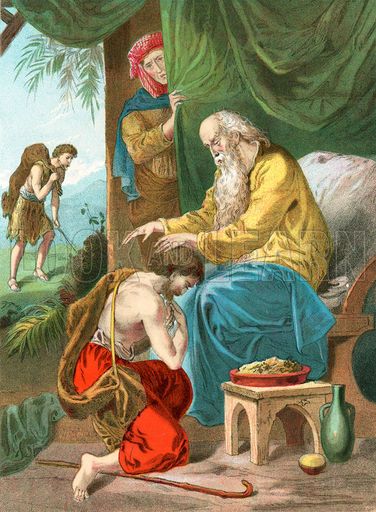
Issac came to be old and blind. Not knowing the day of his death, he wanted to make preparation for passing on his blessing to his older son, Esau. He called for Esau and asked him to go out and hunt wild game and prepare it for him. Then he would be able to give Esau his blessing. Esau's mother, Rebekah, was listening and hoped that her other son, Jacob, would receive the blessing. While Esau was out hunting, she told Jacob to go out to the flock of goats and get one. She would prepare it and have Jacob appear before Isaac to get the blessing.

Now Jacob didn't say something like, "It wouldn't be right", or "That's dishonest". He says, "But my brother Esau is a hairy man, and I'm a man with smooth skin. What if my father touches me? I would appear to be tricking him and would bring down a curse on myself rather than a blessing." His mother said, "My son, let the curse fall on me. Just do what I say; go and get them for me."

She put some of Esau's best clothes on Jacob, and covered his hands and bare neck with goatskins so he would appear hairy. While obeying his dishonest mother, he is now entering a series of soon-to-be lies before his father.

Jacob presented the food to Isaac. Isaac asks, "How did you find it so quickly, my son?" Jacob lies, "The Lord your God gave me success." When Isaac hears the voice as being his other son, Jacob, not Esau, Isaac instructs him to come closer so he can touch him and know whether or not he is Esau. He asks, "Are you really my son Esau?" Jacob says, "I am" (v. 24).

Isaac eats and Jacob waits for his blessing. He obeys his father's request to come closer and kiss him. His father now can smell the clothes of Esau. His senses of touch (v. 22), taste (v. 25), and smell (v. 27) override his sense of hearing (Jacob's voice). He gives a blessing to Jacob:

Ah, the smell of my son is like the smell of a field that the Lord had blessed.
May God give you of heaven's dew and of earth's richness--
an abundance of grain and new wine.

May nations serve you and peoples bow down to you.
Be lord over your brothers,
and may the sons of your mother bow down to you. [Insert Esau here]

May those who curse you be cursed
and those who bless you be blessed.

Ultimately, Esau returned from hunting, prepared the meat, and appeared before his father to receive his blessing. When Isaac realizes he was deceived by Jacob, he "trembled violently" (v. 33). He said to Esau, "Your brother came deceitfully and took your blessing.", and "he will be blessed indeed!" (v. 33).

Esau wept and said he was rightfully named Jacob "deceiver". He had stolen his birthright and now his blessing. Isaac warned that the opposite would be the future for Esau; so, Esau held a grudge against Jacob and planned to kill him. Rebekah warned Jacob to flee to her brother Laban's lands in Haran.


When I read this story, I am just so infuriated at Rebekah! What kind of mother is this?! And apparently her role in helping Jacob deceive Isaac goes unnoticed. She begins complaining about "these Hittite women" that Esau has married. She says that if she has to live with any more of them, her life will not be worth living.

Isaac instructs Jacob to go back to Paddan-Aram (Mesopotamia) to his mother's homeland to find a wife. And then blesses him again!

When Esau hears about this second blessing (rubbing salt in the wound), and realizes how displeasing the Canaanite women are to his father, he goes to Ishmael's family to find a third wife. Remember Abraham's son, Ishmael, was not part of the Abrahamic covenant (the blessing Abraham's descendents would receive by God) since Ishmael was born not by Abraham and his wife Sarah, but by Hagar, Sarah's maid. (See earlier blog.)

Ishmael had already died 14 years earlier, so Esau met Ishmael's son (Nebaioth). He married Nebaioth's sister, Mahalath. He now had 3 unblessed unions with "non-Abrahamic covenant" women: 2 Hittites and 1 Canaanite.

Esau and Jacob part ways until years later. We find in Genesis 33:4, there is an emotional reunion between Jacob and Esau. Esau astonishes Jacob by forgiving him! The two brothers weep and this is an important story in Genesis on the theme of grace.