Tuesday, March 26, 2013

Christian Maturity: A Change of Heart

Inspired by GU’s Christian Service course, Christian Maturity.

 
Do you remember when you were a child and you wanted to have the best toy or the newest game? Or, you set a goal of trying all the flavors of sweet or sour candy, just to say you did? Adults had no time for that. And I remember thinking, “Why don’t they like it?” At some point, they outgrew childhood. They “put away childish things.” Paul wrote in his letter to the Corinthians, “When I was a child, I talked like a child, I thought like a child, I reasoned like a child. When I became a man, I put the ways of childhood behind me” (1 Corinthians 13:11 New International Version).

 
This transition from being a child to becoming an adult goes against what we want when we are young. We want to be forever young and to experience life at its fullest. To have to wait for any “need” or “want” to be met is intolerable. Patience is not fully understood. Not getting that new toy, game, or candy is unimaginable! Disappointing. Even embarrassing, in comparison to other kids who get what they want.

 
Yet for all the indulgence and impatience that children are often accused of, what DO they do right? Their inexperience on this earth causes them to be overly trusting, overly innocent, overly humble. They are by no means perfect, but they are teachable and they follow. Whether an adult guides them to good or to bad, they trust and obey. It is for this reason that Jesus commended little children. Not for their outward actions, but for the condition of their heart.

 
In Matthew 18:2, Jesus called a little child over and said to the disciples, “Unless you change and become like little children, you will never enter the kingdom of heaven.”

 
Can an adult become a child again? Unfortunately, no. But an adult can have a change of heart. Despite his or her experiences on this earth, an adult can become trusting, innocent, and humble.

 
The psalmist wrote:
Create in me a pure heart, O God,
and renew a steadfast spirit within me. (Psalm 51:10 NIV)


King Solomon advised:
Above all else, guard your heart,
for everything you do flows from it. (Proverbs 4:23 NIV)


And Paul encouraged the church members in Philippi by writing:
And the peace of God, which transcends all understanding, will guard your hearts and your minds in Christ Jesus. (Philippians 4:7 NIV)

 
Christian [adults] are often accused of being “other-worldly,” thinking more in terms of faith and heaven, rather than focusing on the “here and now.” The other extreme is to be overly “worldly,” focused on the temporal, often self-centered, or childish. The biblical ideal is to reach a balance—to have confidence in our faith and the reality of heaven, to fulfill our present-day purpose here on earth, and to be aware of our future reward in heaven.

 
Spiritual growth comes only after believing in God as Heavenly Father. To recognize  God as our spiritual Father would mean we are spiritual children. Thus, all believers become members of a spiritual family. We are brothers and sisters in Christ. Does that mean we are literally “family”? No! But, we do have a not-of-this-world opportunity (dare I say, responsibility) to treat one another with kindness, compassion, and brotherly love out of a sincere heart.

 
If we all were to treat one another with civility and spiritual maturity and “put away childish things” of this world, imagine what could be accomplished for good! The book of 1 John expresses this theme. If we say we believe in God and know God, but we do not love God or others, then we do not know God, for God is love.

 
This is how God showed his love among us: He sent his one and only Son into the world that we might live through him. This is love: not that we loved God, but that he loved us and sent his Son [Jesus] as an atoning sacrifice for our sins. Dear friends, since God so loved us, we also ought to love one another. (1 John 4:9–11 NIV)


Wednesday, January 23, 2013

Esau Loses the Blessing

Genesis 27


When Esau was 40, he married two women: Judith and Basemath (both Hittites), and as described in Genesis 26:35, "They were a source of grief to Isaac and Rebekah."

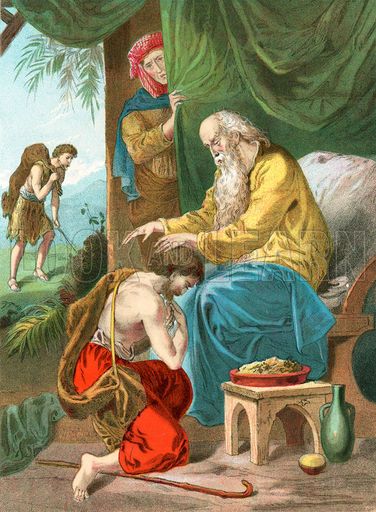
Issac came to be old and blind. Not knowing the day of his death, he wanted to make preparation for passing on his blessing to his older son, Esau. He called for Esau and asked him to go out and hunt wild game and prepare it for him. Then he would be able to give Esau his blessing. Esau's mother, Rebekah, was listening and hoped that her other son, Jacob, would receive the blessing. While Esau was out hunting, she told Jacob to go out to the flock of goats and get one. She would prepare it and have Jacob appear before Isaac to get the blessing.

Now Jacob didn't say something like, "It wouldn't be right", or "That's dishonest". He says, "But my brother Esau is a hairy man, and I'm a man with smooth skin. What if my father touches me? I would appear to be tricking him and would bring down a curse on myself rather than a blessing." His mother said, "My son, let the curse fall on me. Just do what I say; go and get them for me."

She put some of Esau's best clothes on Jacob, and covered his hands and bare neck with goatskins so he would appear hairy. While obeying his dishonest mother, he is now entering a series of soon-to-be lies before his father.

Jacob presented the food to Isaac. Isaac asks, "How did you find it so quickly, my son?" Jacob lies, "The Lord your God gave me success." When Isaac hears the voice as being his other son, Jacob, not Esau, Isaac instructs him to come closer so he can touch him and know whether or not he is Esau. He asks, "Are you really my son Esau?" Jacob says, "I am" (v. 24).

Isaac eats and Jacob waits for his blessing. He obeys his father's request to come closer and kiss him. His father now can smell the clothes of Esau. His senses of touch (v. 22), taste (v. 25), and smell (v. 27) override his sense of hearing (Jacob's voice). He gives a blessing to Jacob:

Ah, the smell of my son is like the smell of a field that the Lord had blessed.
May God give you of heaven's dew and of earth's richness--
an abundance of grain and new wine.

May nations serve you and peoples bow down to you.
Be lord over your brothers,
and may the sons of your mother bow down to you. [Insert Esau here]

May those who curse you be cursed
and those who bless you be blessed.

Ultimately, Esau returned from hunting, prepared the meat, and appeared before his father to receive his blessing. When Isaac realizes he was deceived by Jacob, he "trembled violently" (v. 33). He said to Esau, "Your brother came deceitfully and took your blessing.", and "he will be blessed indeed!" (v. 33).

Esau wept and said he was rightfully named Jacob "deceiver". He had stolen his birthright and now his blessing. Isaac warned that the opposite would be the future for Esau; so, Esau held a grudge against Jacob and planned to kill him. Rebekah warned Jacob to flee to her brother Laban's lands in Haran.


When I read this story, I am just so infuriated at Rebekah! What kind of mother is this?! And apparently her role in helping Jacob deceive Isaac goes unnoticed. She begins complaining about "these Hittite women" that Esau has married. She says that if she has to live with any more of them, her life will not be worth living.

Isaac instructs Jacob to go back to Paddan-Aram (Mesopotamia) to his mother's homeland to find a wife. And then blesses him again!

When Esau hears about this second blessing (rubbing salt in the wound), and realizes how displeasing the Canaanite women are to his father, he goes to Ishmael's family to find a third wife. Remember Abraham's son, Ishmael, was not part of the Abrahamic covenant (the blessing Abraham's descendents would receive by God) since Ishmael was born not by Abraham and his wife Sarah, but by Hagar, Sarah's maid. (See earlier blog.)

Ishmael had already died 14 years earlier, so Esau met Ishmael's son (Nebaioth). He married Nebaioth's sister, Mahalath. He now had 3 unblessed unions with "non-Abrahamic covenant" women: 2 Hittites and 1 Canaanite.

Esau and Jacob part ways until years later. We find in Genesis 33:4, there is an emotional reunion between Jacob and Esau. Esau astonishes Jacob by forgiving him! The two brothers weep and this is an important story in Genesis on the theme of grace.

Isaac in the Valley of Gerar

Genesis 26


Now there was a famine (again) in the land and Isaac went to King Abimilech of the Philistines in Gerar. The distinction Abimelech was a title similar to Pharaoh, so this was not the same king Abimelech of Genesis 20, 97 years later. I found this map to show where Issac's journeys are with references to chapters in Genesis :)


The Lord appeared to Isaac and told him to stay in Gerar, and to not go down to Egypt for a while. Isaac feared that if the Philistines wanted to have his wife, Rebekah (she was beautiful), then they would kill him and take her. So, he told Abimelech that she was his sister. Some time passed, and one day, the king saw Isaac (from a window) caressing his wife. He became furious! He summoned Isaac and questioned why he lied to them, realizing that if he or one of his men had taken advantage of her, then guilt would have been put on the whole house. So Abimelech gave orders that anyone who bothered Isaac or Rebekah would be put to death.

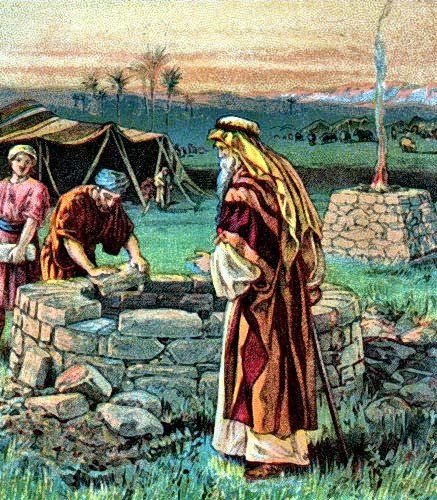
Isaac set himself to work planting crops and was blessed one hundred fold that year. He became rich, even wealthy, with flocks, herds, and servants. The Philistines envied him and began to fill up his wells with dirt. King Abimelech ordered him to move away to the valley of Gerar. There, he built wells again, but the first one (Esek), and the second (Sitnah), were filled with dirt again by quarreling herdsmen. Finally, he moved far enough away from all the herdsmen that he had plenty of room, and there they flourished. The Lord appeared to Isaac, and so he built an altar to the Lord and worshipped, which was in keeping with the Abrahamic covenant of his father and the Lord. This happened at Beersheba (see above map).

King Abimelech came to visit, with his personal adviser, Ahuzzath, and the commander of his forces, Phicol. Isaac questioned why they came to visit since recently he was sent away. Abimelech feared the power of Isaac and wanted to make a peace treaty with him. They stayed until the next day and feasted. Then left in peace. After their departure, Isaac's servants came to him and announced finding water in the well. They named the well "Shibah", which means "oath". The city of Beersheba is named from Shibah.

Jacob, Esau, and that Red Lentil Stew!


Genesis 25:19-34

Abraham’s son, Isaac, was 40 when he married Rebekah, the daughter of Bethuel and sister of Laban. Isaac prayed for his wife Rebekah since she was barren, and in Genesis 25:21, “the Lord answered his prayer, and his wife Rebekah became pregnant.”  There were two babies jostling around inside her, so she prayed to the Lord about what was happening. The Lord said, “Two nations are in your womb and two peoples from within you will be separated; one people will be stronger than the other, and the older will serve the younger.” The first boy to come out was hairy and red, so they named him Esau. Edom also means red, so Esau is at times referred to as Edom. The second boy came out with his hand grasping Esau’s heel, so he was named Jacob “he grasps the heel”, or, “he deceives”. Isaac was 60 when Rebekah gave birth to them; this was 20 years after he married Rebekah.
Esau became a skillful hunter, while Jacob was a quiet man and preferred to stay home among the tents. Their father, Isaac, had a taste for wild game, so he loved Esau; but, their mother Rebekah loved Jacob.

Esau came in from the open country famished and asked Jacob for a bowl of red stew. Jacob asked for Esau’s birthright in return. Esau said, “Look! I am about to die [of hunger]…what good is the birthright to me?” Jacob made him swear an oath. Then Jacob gave Esau some bread and red lentil stew. He ate and drank, then got up and left, despising his birthright.

My summary wouldn’t be complete without finding a recipe for Jacob’s red lentil stew! I came across this fascinating website, “The History Kitchen”. The author gives a wonderful history of ancient Israelite cooking, including step-by-step photos and instructions on how to prepare a historically similar red lentil stew. The lentils are red, but they turn a light brown when cooked. If the above link gives you trouble, click here. Now, if my family only enjoyed lentils, we could have a feast worthy of stealing a birthright!


Tuesday, January 8, 2013

Abraham in Genesis 21-25:18


My journey through Genesis continues! These are the characters and situations I encountered in Genesis 21-25:18. And so I can continue with my trek through the Old Testament, and the REST of the Bible, a brief summary of the stories.
This online summary primarily serves as an academic exercise for me, but it may serve a purpose to others who are interested in Old Testament Literature, or at least, in seeing the lessons learned from these biblical accounts. Originally, I was going to post a more thorough discussion of these chapters, but my recap will have to do for now.

GENESIS 21-25:18
Genesis 21 – Abraham and Sarah have their promised son (Isaac). Sarah’s maidservant, Hagar, and Abraham’s other son (by Hagar), Ishmael, are sent away to wander in the desert of Beersheba.


It was recorded in Genesis 21:18 that God told Hagar to not worry; He heard the cries of the boy in the desert, and He would be with him and make him into a great nation.
Genesis 22 – God requires Abraham to offer a sacrifice; but requires the sacrifice to be his only son, Isaac. At the point of taking Isaac’s life, God provides a scapegoat as the sacrifice and Isaac is spared.


The lesson in this story is that God wants to see if Abraham fully trusts him. God does not really intend to harm the boy; this is an early foreshadowing of how God would send His one and only Son, Jesus, to be sacrificed on the Cross as the penalty for the sins of the world.

Genesis 23 – Abraham’s wife (Sarah) dies and Abraham purchases land in Canaan to bury her, which would also later be the burial place for himself, Isaac and Rebekah, Leah (not Rachel—she died on a journey), and Jacob.
Genesis 24 – Abraham requests his chief servant (in charge of his household) to go and find a wife for Isaac, not "from the daughters of the Canaanites...but...go to my country and my own relatives..."(v. 4). The servant prays and is led by God to find Rebekah, the granddaughter of Abraham's brother. The servant and Rebekah's family discuss if Rebekah should go, but then ask her what she thinks, and in the end, she decides to go with the servant to marry Isaac. In verse 67, we read that Isaac loved Rebekah, and he brought her into the (former) tent of his mother, Sarah (who had recently died), and he was comforted by having Rebekah as a companion and wife.
Genesis 25 – Abraham dies at the age of 175. Ishmael dies at the age of 137. It is recorded that he had 12 sons, which became 12 tribes; his descendants settled “from Havilah to Shur”, near the Egypt border. His sons are: Nebaioth, Kedar, Adbeel, Mibsam, Mishma, Dumah, Massa, Hadad, Tema, Jetur, Naphish, and Kedemah. In 25:18, “And they lived in hostility toward all their brothers.” Or, the NIV reads, “And they lived in hostility toward all the tribes related to them.”
Ishmael’s Sons (Genesis 25:12-18)
http://www.biblegateway.com/passage/?search=Gen.25.12-Gen.25.18

Despite the previous resentment and jealousy between Sarah and Hagar, and consequently, Isaac and Ishmael, we find in Genesis 25:9, “His sons Isaac and Ishmael buried him [together]…”. He was buried on the land which he purchased for Sarah’s burial, which would serve as a family burial ground again later.

Even after Abraham's death, a lesson is learned in the peaceful assembly of Isaac and Ishmael out of respect and custom to bury their father (25:9).

Asbury Bible Commentary on Genesis Patriarchal History:


Monday, November 14, 2011

Don't Look Back--Talk to God

Well, today has been a typical Monday. I was going to take a break from Genesis tonight, but knowing that the next couple of chapters were on the destruction of Sodom and Gomorrah, it just seemed to be “apropos” :]

(Genesis 18-19)

The Lord appeared to Abraham one day while he was sitting at the entrance of his tent in the heat of the day. Three visitors came (angels), and Abraham hurried to meet them and bowed before them, ready to assist them. He offered to bring water for them to wash their feet, and offered refreshment for them while they rested. When they were ready to leave, the Lord decided to let Abraham know about the grievous state of Sodom and Gomorrah.

The Lord said,
The outcry against Sodom and Gomorrah is so great and their sin so grievous that I will go down and see if what they have done is as bad as the outcry that has reached me. If not, I will know. (18:22)
Then Abraham stood before the Lord and pled for the salvation of these cities. This is the first record of a person praying for the sparing of another person in the Old Testament. Abraham asked,
Will you sweep away the righteous with the wicked? What if there are 50 righteous people in the city?...Far be it from you to do such a thing--to kill the righteous and the wicked alike. Far be it from you! Will not the Judge of all the earth do right? (18: 23-33)
Abraham continued to be so bold as to beg for 45, 40, 30, 20, and finally 10 people. The Lord agreed, “For the sake of 10 [righteous people], I will not destroy it” (18:32).

When the two appointed angels arrived at the gateway of the city, Lot happened to be there. When he saw them, he offered for them to stay in his house, where they could clean up, eat, and rest from their journey. Lot feared for their safety and sought to protect them from the perverted men in the city square. Soon, men of all ages surrounded the house and called for Lot to bring the men outside. Lot went outside to make them go away. He remembered his two virgin daughters inside and offered them to the men. They refused and tried to break down the door. The men inside (the angels) reached out and pulled Lot back inside the house and shut the door. Then they struck the men outside with blindness so they couldn’t find the door.

The two angels instructed Lot to leave the city with any others who belonged to him, because they were sent by the Lord to destroy this wicked place. So Lot went to speak with his future sons-in-law, who were pledged to marry his daughters. They thought he was joking, so they did not leave. At dawn, Lot hurriedly left with his wife and two daughters. The Lord was merciful to them.

One of the angels said to them,
Flee for your lives! Don’t look back, and don’t stop anywhere in the plain! Flee to the mountains or you will be swept away! (19:17)
Lot pled with them to let them go as far as Zoar, a smaller town nearby, instead of the mountains. Then the Lord rained down burning sulphur on Sodom and Gomorrah; but, before it was all over, Lot’s wife disobeyed and looked back, and she turned into a pillar of salt (19:26).

God remembered Abraham’s appeal for the safety of the righteous. His pleading with the Lord is similar to a "prayer of faith", and that is why his nephew Lot was spared.

In the New Testament, James (a brother of Jesus) explained the importance of praying by faith. Such a prayer can make a sick person well, bring physical and emotional healing, and cover a multitude of sins:
Is anyone among you in trouble? Let them pray. Is anyone happy? Let them sing songs of praise. Is anyone among you sick? Let them call the elders of the church to pray over them and anoint them with oil in the name of the Lord. And the prayer offered in faith will make them well; the Lord will raise them up. If they have sinned, they will be forgiven. Therefore confess your sins to each other and pray for each other so that you may be healed. The prayer of a righteous person is powerful and effective. Elijah was a human being, even as we are. He prayed earnestly that it would not rain, and it did not rain on the land for three and a half years. Again he prayed, and the heavens gave rain, and the earth produced its crops. My brothers and sisters, if one of you should wander from the truth and someone should bring them back, remember this: Whoever turns a sinner from the way of error will save them from death and cover over a multitude of sins. (James 5: 13-20)

Sunday, November 13, 2011

Circumcision of the Heart

When Abram was 99, the Lord appeared to confirm his earlier covenant with Abram. He desired for Abram (and mankind) to "walk before Him and be blameless" (Genesis 17:1).

God declared that Abram would no longer be called Abram, “exalted father”, but Abraham, “father of many”. God also told Abraham to no longer call his wife, Sarai, “my princess”, but Sarah, “a princess”. She would be the mother of nations, beginning with her firstborn son, Isaac.

Abraham fell face down and laughed, thinking to himself, “Will a son be born to a man 100 years old? Will Sarah bear a child at the age of 90?” Having lived in Canaan for about 23 years, Abraham was still considered a foreigner, but God pledged to give this land to him and his descendants as an everlasting possession (Genesis 17: 7-8).

Then Abraham remembered his firstborn son Ishmael (from Hagar). He pled to God, “If only Ishmael might live under your blessing!” God reassured Abraham that Ishmael would not be forsaken; he would be blessed and his descendants would increase in number. He would be the father of 12 rulers, and he would be made into a great nation. This covenant, however, would not be established through him; rather through Abraham and Sarah’s son, Isaac.

As an outward sign of the everlasting covenant made between Abraham and God, all the male members of Abraham’s household, including those to come in future generations, would be required to undergo circumcision. This act would be expected of every male at least 8 days old, including those bought with money from a foreigner. Any male, who would not circumcise the flesh, will have broken the covenant requirement and will be cut off from his people.

So on that very day, Abraham (age 99), Ishmael (age 13), and all other males in the household were circumcised. For Abraham to undergo this procedure (and require it of his entire household) signified his belief in the faithfulness and judgment of God.

It was not merely for physical reasons that circumcision was required. It was to show outwardly what had been pledged inwardly--a total submission and devotion to God. The cutting away and removal of flesh was symbolic of the cutting away and removal of fleshly desires (carnality) in the life of a person who is said to be godly, or righteous. This is symbolic of a "circumcision of the heart", by the Spirit of God.

This spiritual "circumcision of the heart" is available to all who walk in the footsteps of faith of Abraham (Romans 4:12, 20-25).